
Criminal Cases in the Oregon Courts
Oregon Circuit Court is the main trial court. A circuit court serves each of Oregon's 36 counties, grouped into 27 judicial districts. These courts have general trial power over felony, misdemeanor, violation, traffic, and juvenile matters. The filing county's circuit clerk keeps the case record. Treatment courts for matters such as drug, DUII, mental health, and veterans cases operate within an underlying trial case rather than creating a separate statewide record system.
Municipal and justice courts form a separate local layer. They may hear some violations and misdemeanors, but they cannot try felonies. Their records may not appear in the Oregon Judicial Department portal. Most criminal appeals from circuit court go to the Oregon Court of Appeals, while the Oregon Supreme Court is the highest state court. The trial file and later appellate file remain distinct, so a complete Oregon court record review may require both.
Search All Oregon Circuit Courts
The free OJD Records and Calendar Search covers basic public data from Oregon circuit courts, Tax Court, Court of Appeals, and Supreme Court. It does not provide filed documents. It also omits adoption, juvenile, mental health, qualifying Violence Against Women Act matters, and other protected data. The first 200 results are shown, which makes a broad common-name query incomplete.
The official OJD web portal provides the free statewide interface shown below. Its layout shows why the name, number, date, and court filters matter.
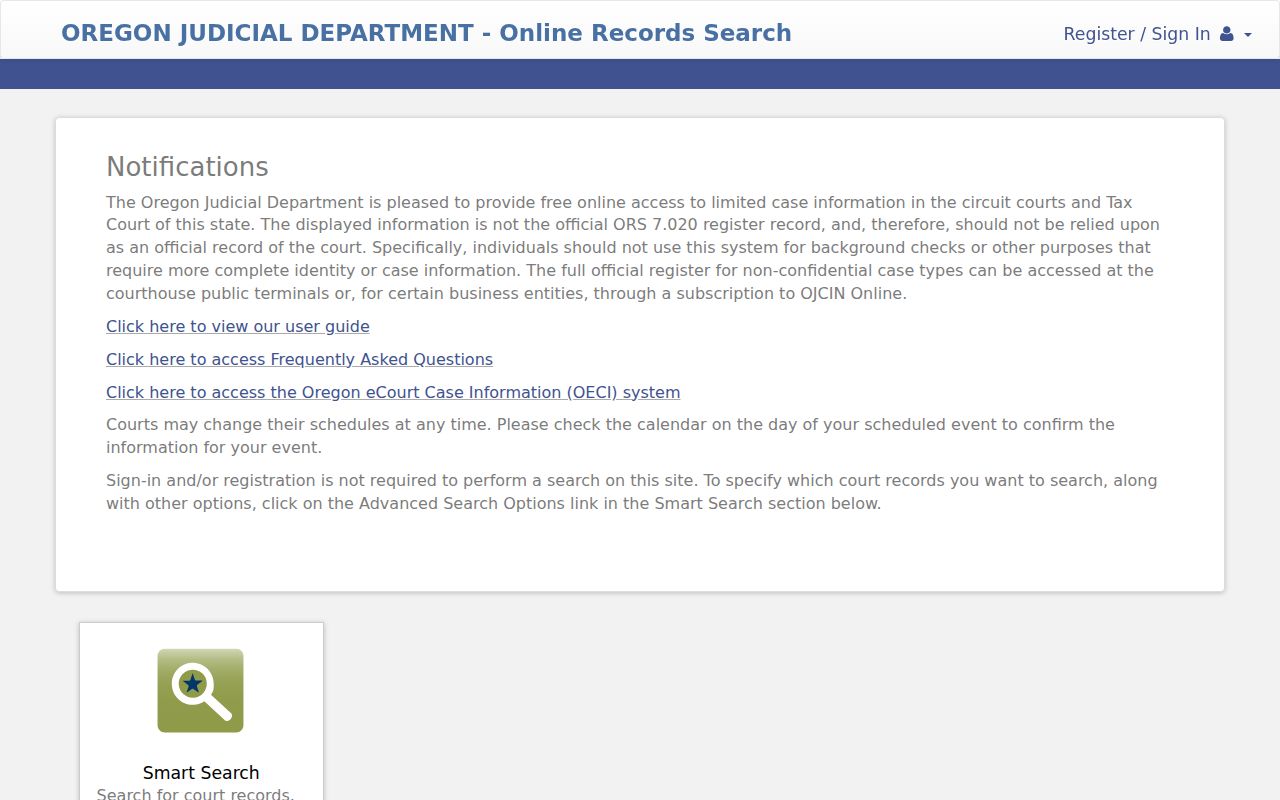
The statewide index is a strong starting point, but the court location and case status must be verified before ordering an Oregon case document.
Note: A broad Oregon name search can stop at 200 results, so add a court location and filed-date range before ruling out a case.
How to Search Oregon Judicial Department Records and Calendar Search
Begin with the most precise identifier available. An exact case or citation number avoids many same-name problems. If only a name is known, the Oregon portal expects the form Last, First. A wildcard can help with a partial spelling, while Sounds Like can help with phonetic variants. Those two aids cannot be combined.
- Open the free Oregon Records and Calendar Search and choose Smart Search.
- Enter a case number, citation number, or party name. Use at least four number characters, or the portal's minimum name characters.
- Narrow the result by court location, Cases and Judgments category, and filed date.
- Check the case number, type, status, and location, then review Case Information, Party, Events and Hearings, and Financial tabs.
- Ask the filing court for the exact charging paper, judgment, register, audio, or certified copy when online data is not enough.
| Field Label | Type | Required | Notes |
|---|---|---|---|
| Smart Search | Text | Yes | Case or citation number, or party name in Last, First form |
| Sounds Like | Checkbox | No | Phonetic aid; cannot be used with the wildcard |
| Search Type | Menu | No | Includes party, nickname, case, citation, attorney, and judicial officer |
| Court Location | Menu | No | All locations, one of 36 circuit locations, or Tax Court |
| Filed Date | Date filter | No | Helps narrow results before the 200-record cap |
The official OJCIN overview also illustrates the statewide court coverage and the difference between free summary data and subscription access.
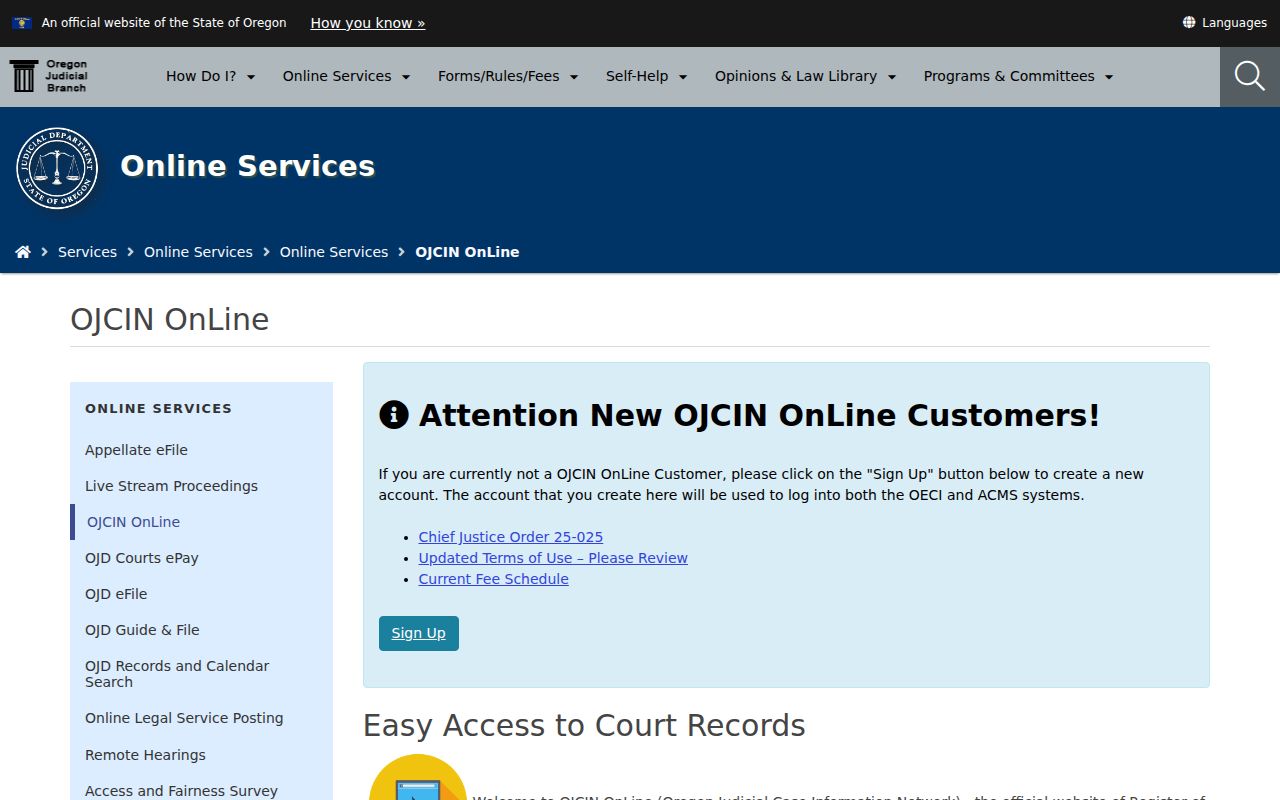
That distinction prevents a basic portal result from being mistaken for the complete official register of actions.
OJCIN and Free Oregon Records
OJCIN OnLine reaches OECI records from all 36 circuit courts and Tax Court, plus ACMS appellate records. Public felony and misdemeanor registers appear there, while confidential records remain excluded. The free Oregon portal supplies basic case and calendar data without documents. OJCIN supplies fuller register and judgment-docket detail, but an account does not guarantee access to every document image.
Under the fee schedule effective September 1, 2025, OJCIN has a $170 nonrefundable setup fee. General access without documents is $36 per month plus $17 per user profile. Eligible document access is $117 per month plus $17 per profile. Public courthouse terminals remain the no-subscription route for fuller inspection.
| Oregon channel | Best use | Main limit |
|---|---|---|
| Free OJD search | Locate basic public cases and calendars | No documents; 200-result cap |
| OJCIN/OECI | Official register and judgment-docket detail | Paid; document eligibility varies |
| Public terminal | Fuller inspection without an online subscription | Requires courthouse access |
| Filing court clerk | Exact copy, audio, or certification | Case and document details are needed |
The official OJCIN signup page shows the account path and its access qualifications.
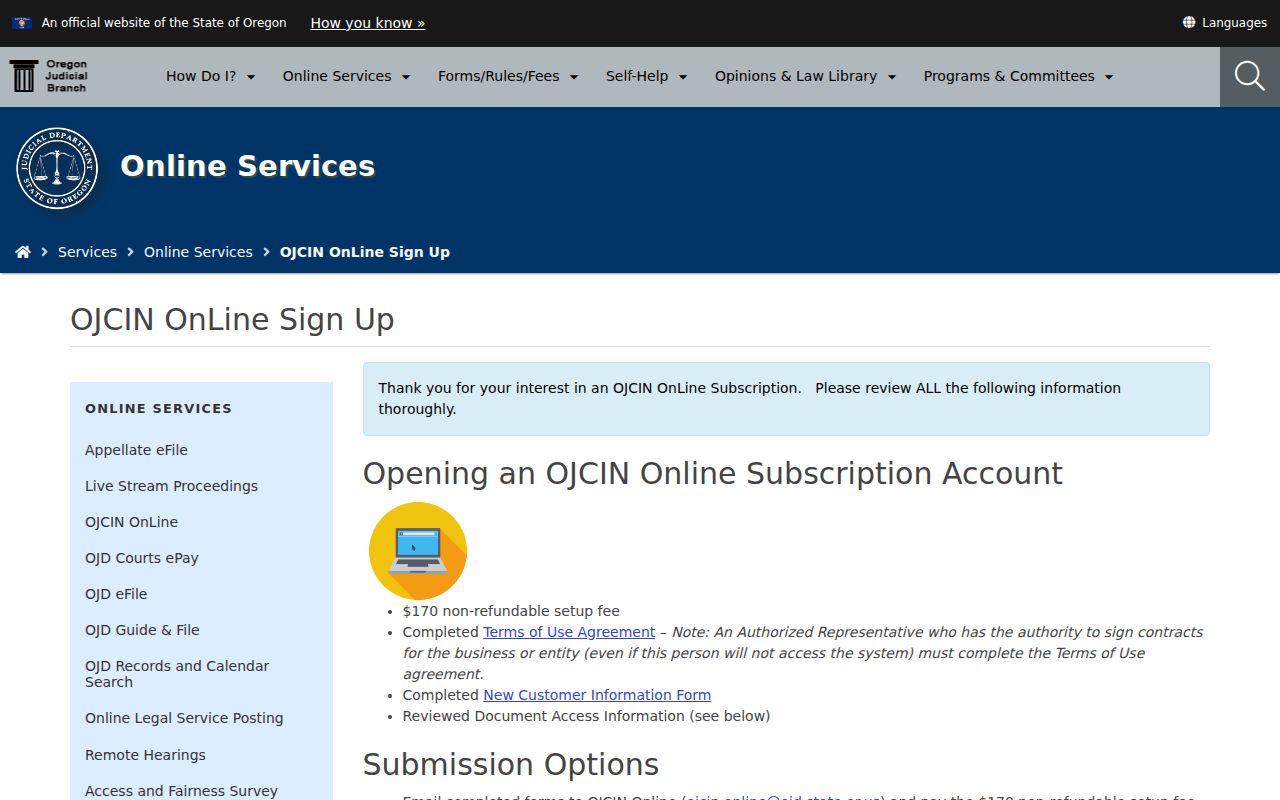
Readers who do not qualify for linked documents can still inspect public records at a circuit courthouse and request a named item from the clerk.
What the Case File Shows
An Oregon criminal case file ties allegations, court events, and outcomes to a case number. Read each count separately. An initial charge may be amended, dismissed, or resolved under a different statute. The event list can show when a paper was filed or a hearing was set, but the final judgment is the best source for conviction and sentence terms.
| Case Number & Court | Identifies the filing venue and the specific Oregon court matter. |
|---|---|
| Charging Documents | Complaint, information, or indictment stating the filed allegations. |
| Docket Entries | Chronological filings, notices, warrants, hearings, and judgment events. |
| Hearing Dates | Scheduled event, status, judicial officer, and location where public. |
| Disposition | Outcome by charge, such as conviction, dismissal, or acquittal. |
| Sentence & Judgment | Authoritative terms for custody, probation, fines, restitution, and conditions. |
Protected identifiers, victim information, sealed material, and confidential attachments are not part of the public display. The Financial tab may show public assessments, balances, and payments, but it does not replace the judgment's language.
Note: A charging document states allegations; only the disposition and judgment establish how an Oregon criminal count ended.
Read Oregon Court Events Carefully
OECI distinguishes an event's Date, Signed Date, and Created Date. Created Date is the entry date used for the official register under ORS 7.020. A scheduled hearing does not prove the hearing occurred. Check its status and the later events. Likewise, a row labeled Judgment points toward an outcome, but the judgment document controls the sentence.
- Arraignment
- The appearance where charges are stated and a plea is taken or scheduled.
- Disposition
- The recorded result of a charge or case, such as conviction, dismissal, or acquittal.
- Indictment
- A grand jury accusation that permits charges to proceed, not a finding of guilt.
- Register of actions
- The official chronological record of Oregon case events.
- Set aside
- An ORS 137.225 order that seals qualifying official court and arrest records.
A criminal category can include contempt, extradition, juvenile delinquency, or an appeal from a local court. Category alone does not establish a conviction. Confirm the case type, each count, the disposition, and any later appellate order.
Stages of an Oregon Criminal Case
A police report or arrest may come first, but the district attorney decides whether and what to file. A complaint, information, or indictment starts or continues the Oregon court file. Arraignment records the first plea stage. Pretrial motions and hearings can change what evidence or charges remain. A plea or trial produces an outcome, followed by judgment and sentencing when there is a conviction.
Case flow: Charges Filed › Arraignment › Pretrial › Plea or Trial › Disposition › Sentencing
Later entries may record a warrant, probation issue, set-aside motion, amended judgment, appeal, or appellate mandate. The OSP repository receives qualifying disposition reports, but its person-centered history does not reproduce all pleadings or every court event. For that detail, return to the Oregon case record.
When an Oregon Case Is Missing
A missing online result does not prove that no case exists. The spelling may differ, the filing may be new, the location may be wrong, or the matter may sit in municipal, justice, federal, or tribal court. Protected and set-aside cases also will not appear like ordinary public cases. Start by trying name variants, then narrow by location and filed date.
Next, use a public courthouse terminal or contact the filing clerk. Oregon law allows examination of court records in the clerk's custody subject to confidentiality rules. Juvenile, adoption, mental health, and qualifying VAWA matters have special limits. A federal case belongs in PACER and the District of Oregon, not the OJD portal.
Note: Public access rules can hide a case or document without erasing the underlying Oregon court event from every authorized system.
Request an Oregon Court Copy
The filing court can supply the charging document, judgment, register print, hearing audio, or a certified copy when public. OJD recommends giving the case number, exact document description, and hearing or document date. Its central court records request page helps identify the proper route and notes that a response may take up to five court business days, with longer fulfillment communicated separately.
The official Oregon court request page provides a clear source view of the document-access path.
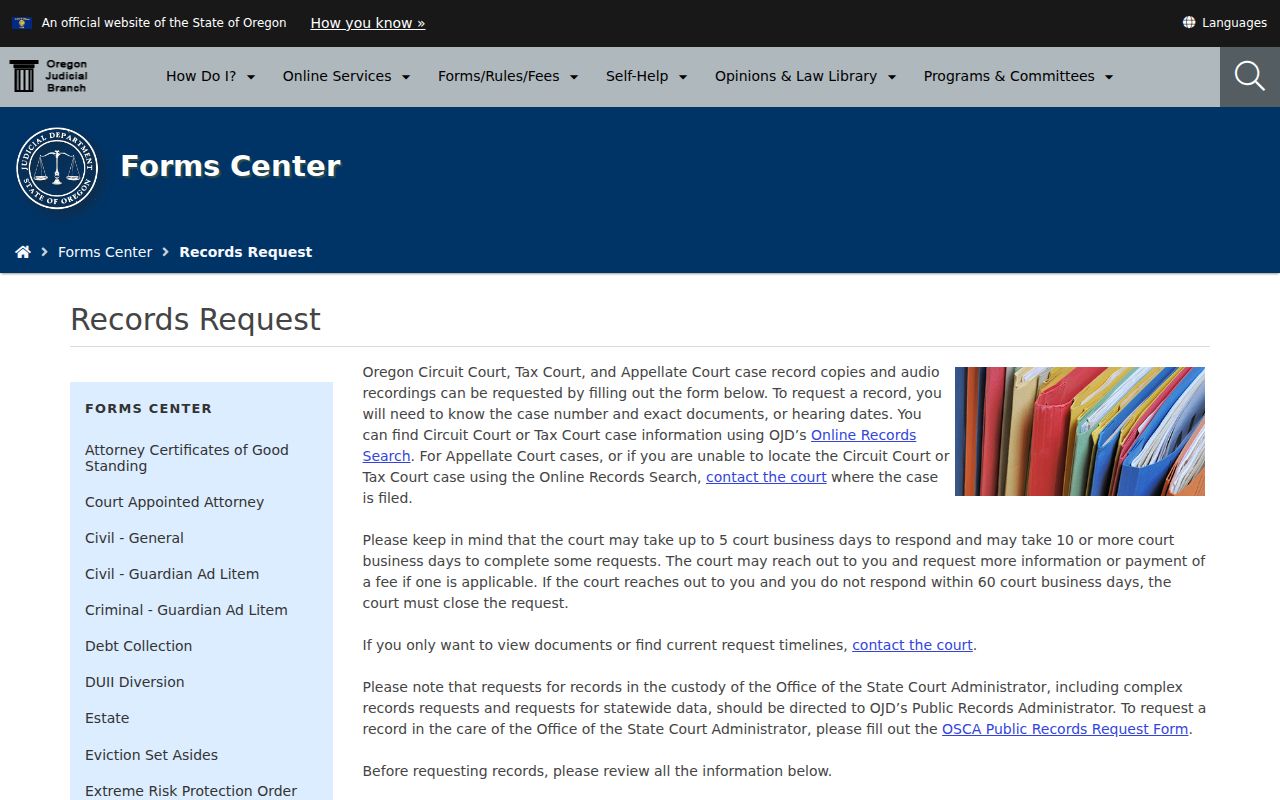
A response date is not always the delivery date. Copying, certification, audio work, redaction, and archive retrieval can affect cost and timing.
Finding Case Records by County
The complete Oregon trial file stays with the clerk of the court where it was filed. Circuit matters go to the county's circuit court. Municipal cases go to the city court, and justice court matters go to that local court. Do not send a general public-record request to OJD headquarters when one filing court owns the requested record.
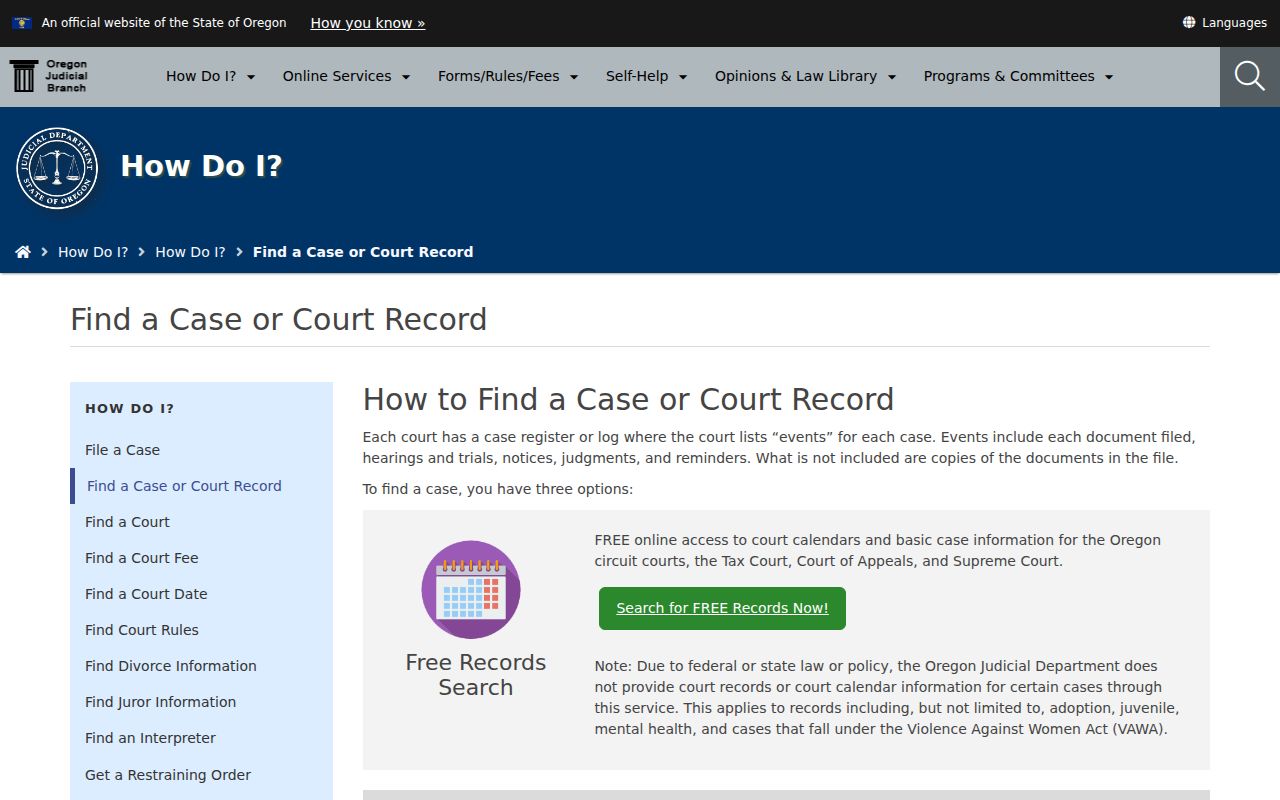
The official Find a Court Record page reinforces the clerk fallback when online tools do not provide the needed file.
Use the directory of all 36 Oregon counties to identify the correct local route. Bring the case number, party name, date range, and exact item requested. That source-first approach is more reliable than treating a statewide summary as the full Oregon criminal court file.