
About Oregon State Police CJIS
Oregon State Police CJIS sits within the Public Safety Services Bureau. State law directs OSP to maintain fingerprint and identity filing and retrieval systems, then supplement them with criminal information. The division's Computerized Criminal History system, or CCH, is the person-centered repository. It is supported by the Automated Biometric Identification System, which matches new fingerprints to an existing file or creates a new identity file.
The same division also operates or coordinates LEDS, public fingerprint service, Oregon Uniform Crime Reporting, registry functions, criminal-justice audits, and technical services. Those programs share infrastructure, but they do not form one public database. LEDS exchanges warrants and protection orders for authorized agencies. UCR publishes statistics. CCH holds compiled person histories. Public access depends on the law governing each product.
The OSP CJIS criminal history products page is the official starting point for current services and fees.
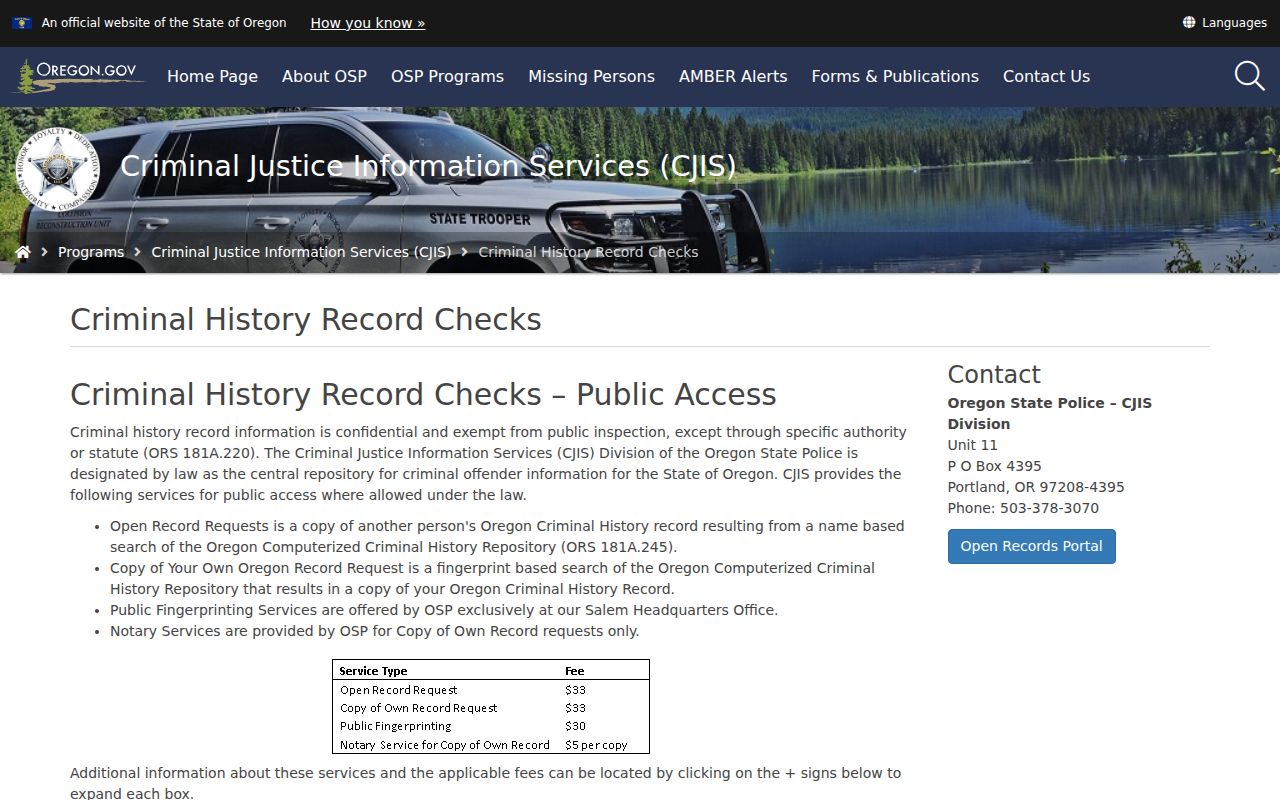
Its separate product descriptions matter because paying for fingerprint capture alone does not order a criminal history response.
OSP CJIS Fingerprint History
Oregon State Police says its criminal fingerprint files date to the 1920s. State Police became a statewide agency in 1931, but no official source located a single opening date for a separately branded repository. The defensible history begins with the fingerprint file and continues through the modern duty in ORS 181A.140. It should not be turned into an invented founding story.
Paper cards later gave way to livescan and automated biometric matching. Oregon also joined the Western Identification Network and federal identity exchange for authorized justice use. By 2019, a state budget document reported about 94 percent of arrest cards arrived electronically. A later budget reported 98.7 percent electronic in 2021, with an average 42-minute electronic posting time. Those dated averages describe repository intake, not a promised public-request turnaround.
Note: Oregon's electronic posting speed does not replace the statutory notice period for a public name-based request.
Criminal History Checks Offered by OSP CJIS
OSP CJIS has distinct products for distinct questions. The Open Record on another person is name-based and limited by Oregon disclosure law. The Copy of Own Record uses current fingerprints and goes only to the record subject. Public fingerprint capture is a service used to create a hard card, not a search. Authorized regulatory programs may have separate Oregon or FBI components controlled by the initiating program.
| Product | Who May Order | What It Returns | Cost |
|---|---|---|---|
| Open Record | Any requester with required descriptors | Limited Oregon convictions and qualifying recent unresolved arrests | $33, nonrefundable |
| Copy of Own Record | The record subject | Fingerprint-confirmed Oregon CCH copy or clearance response | $33 |
| OSP fingerprint capture | Person needing a hard fingerprint card | Fingerprint capture only, no history result | $30 |
| Own-record notarization | Own-record requester | Notarized OSP response | $5 per copy |
| Set-aside check | Eligible ORS 137.225 applicant | Repository check used in the clearing process | $33 |
| Authorized state check | Program authorized by statute | Program-defined fingerprint response | $33 OSP component, plus any capture or federal fee |
Fees and scope are not interchangeable. Fieldprint may collect prints for a coded agency process, while OSP remains the repository and the responsible program receives the result.
OSP CJIS Open Records Portal
The Oregon Open Records portal supports account login, account creation, and direct card payment. An account does not grant browsing access to CCH. Each request searches Oregon records using a name and descriptive details. The portal requires the subject's current or last-known address because OSP must send notice when releasable information exists.
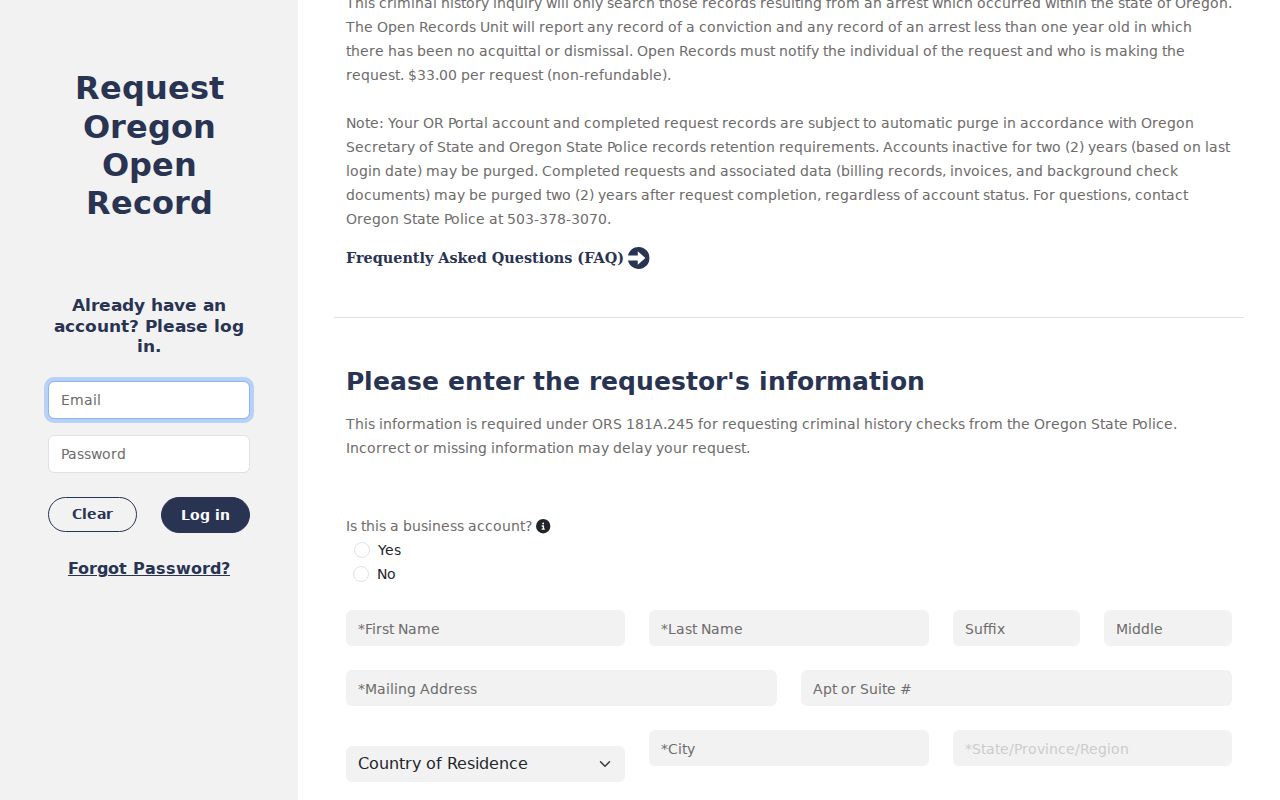
The login screen is an ordering gateway, not an instant conviction index or a national record search.
A requester supplies last, first, and middle name; aliases or maiden names; birth date or approximate age; current or last-known street address, city, state, and ZIP; and requester contact information. Social Security number can be added when known. Payment is $33 even when no match is returned. OSP later mails the result rather than opening a live rap sheet in the account.
How Records Flow Into the OSP CJIS Repository
A local sheriff, city police officer, state trooper, tribal officer, campus officer, or other authorized agency creates the arrest event. When a person is booked, fingerprints and arrest identifiers travel by livescan or card into OSP CJIS. ABIS checks identity. A match adds the cycle to an existing file. No match creates a new file. The transaction control number helps connect later court reporting to that arrest.
Data flow: County Arrest › Fingerprint Submission › Oregon State Police CJIS › Court Disposition Reporting › Rap Sheet
Prosecutors and courts then create the case and report its disposition. Older cards, rejected messages, name variation, bad coding, or an unmatched disposition can create gaps. A 2018 state audit documented electronic court-interface exceptions that needed manual work, but that finding is too old to claim a current error rate. The source agency or court must correct its event before OSP can reliably update the compiled history.
OSP CJIS Fourteen-Day Notice
ORS 181A.245 makes the public Open Record deliberately slower than a public portal search. If OSP finds information that can be released, it identifies the requester to the subject and gives the subject fourteen days to inspect or challenge the record. Authorization from the subject does not waive that interval. The goal is to provide a chance to address mistaken identity or an incorrect source event before mailing.
The OSP Open Records FAQ documents the Oregon-only scope, fee, and notice process.
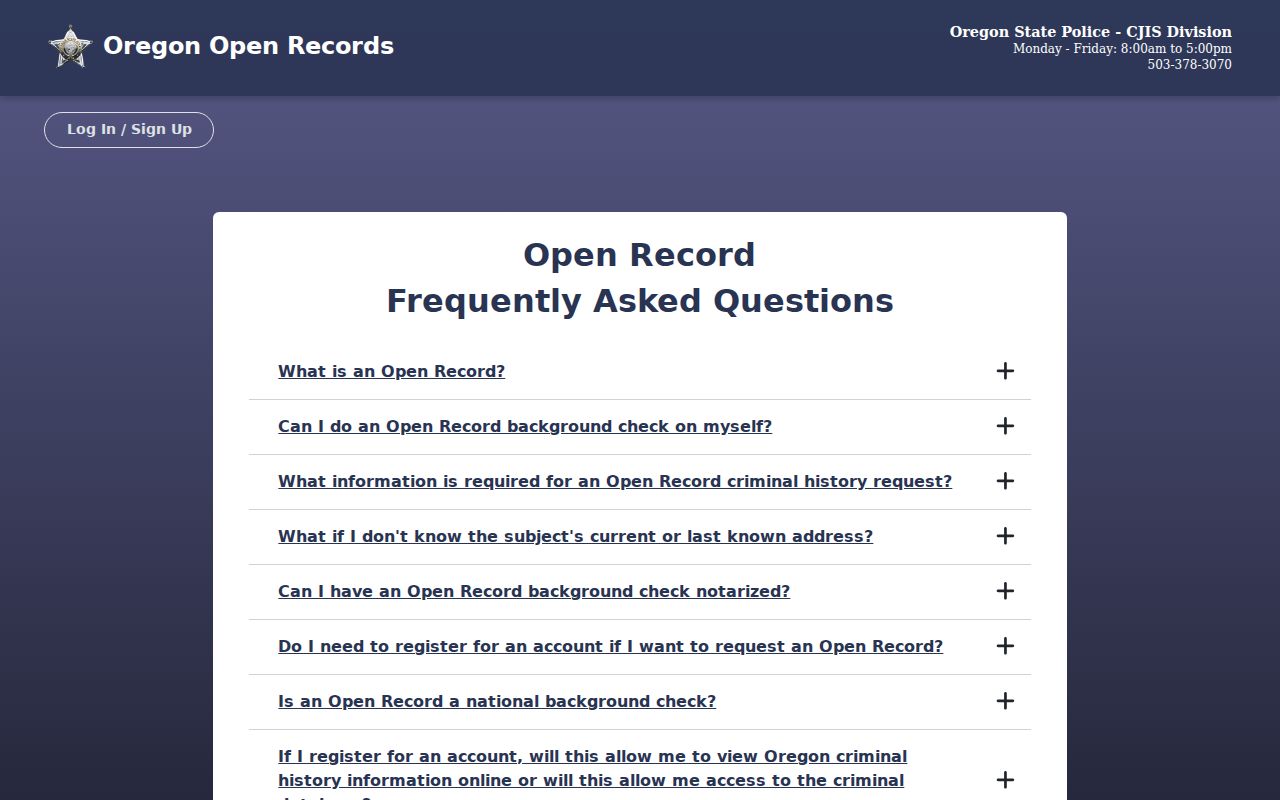
The FAQ also explains why “no criminal record” can mean no publicly releasable Oregon record, not proof that no arrest or case ever existed.
When released, the response may show an arrest date, offense, agency, court of origin, disposition, sentence, or parole and revocation details. It excludes other-state and federal history. Because the match is name-based, OSP warns that similar names and descriptions do not provide fingerprint confirmation.
How to Order an OSP CJIS Check
Choose the channel by the question. Use Open Record to request the limited record Oregon may disclose about another named person. Use Copy of Own Record to inspect your fingerprint-confirmed Oregon file. Use Oregon court channels for pleadings, judgments, and event detail. A direct FBI Identity History Summary is the subject-only route for a national fingerprint file.
- Select Open Record, Copy of Own Record, or the authorized program named in your official instructions.
- Gather the required names, address details, form, and current fingerprints when the product calls for them.
- Submit through the OSP portal, the correct mail address, or the channel supplied by the authorized program.
- Pay each listed component and keep the receipt. Fingerprint capture and the history request are separate services.
- Read the response against the source court or agency file before treating an entry as complete.
The paper Request on Another Individual remains a mail alternative to the portal. It requires the subject's full name, birth date, current or last-known address, requester details, and the $33 payment. Incomplete or illegible data can delay matching.
OSP CJIS Personal Record Review
The Copy of Own Record is the strongest Oregon self-review because current fingerprints reduce name-match uncertainty. OSP requires a fresh FD-258 hard card with clear rolled and plain impressions, identity details, and signatures. It will not reuse old prints for this product or accept electronic transmission of these particular self-review prints. The result is mailed only to the subject.
OSP lists a normal processing range of seven to ten business days, excluding mail, and no routine expedite. The record fee is $33. OSP public fingerprint capture in Salem costs another $30, and notarization costs $5 per copy. A person may use another fingerprint provider, but the card still must meet OSP's requirements. Mail payments use check or money order; current OSP instructions control counter payment methods.
For a national self-review, the FBI charges $18 for an Identity History Summary requested through its electronic portal, mail, a participating USPS site after enrollment, or an approved channeler. Oregon's own-record result remains Oregon-only.
OSP CJIS Checks vs County Records
An OSP CJIS history organizes reported, fingerprint-linked arrest cycles around a person. An Oregon circuit court organizes events and documents around a case number. A county jail creates the booking record, while an arresting agency holds its incident report. The state rap sheet can connect events from across Oregon, but it does not replace those original files.
| Question | OSP CJIS Check | County Record |
|---|---|---|
| Coverage | Reported Oregon repository events | One county's court, jail, or agency file |
| Identity | Name-based public product or fingerprint self-review | Case, booking, or incident identifiers |
| Timing | Depends on contributor reporting and matching | Updates as the local event or case moves |
| Detail | Compiled arrest and outcome summary | Pleadings, docket events, judgment, report, or booking facts |
| Best use | Statewide personal history review | Verify the source and understand the case |
Neither source always wins. Compare them. Use the Oregon county directory to reach the local records site when a repository line needs its original case, arrest, or booking context. For statewide case access, the Oregon criminal court case page separates the free and subscription routes.
OSP CJIS and LEDS Access
LEDS is a restricted justice-agency network, not a public lookup product. It carries warrants, protection orders, stolen property, criminal histories, and other operational information. Its round-the-clock availability to authorized users does not create public portal access. A person seeking a warrant should contact the court or responsible local agency, not try to open LEDS.
Likewise, Oregon UCR dashboards contain aggregate offense and arrest statistics. They do not identify a person's criminal history. Rap Back is another distinct service. Legislation in 2024 authorized federal NGI Rap Back participation for qualifying recurring-check programs. Enrolled fingerprints can support later authorized notices, but Rap Back is not an upgrade to an Open Record request and is not available as a general name search.
The OSP Criminal Justice Information Services overview separates these units and their functions.
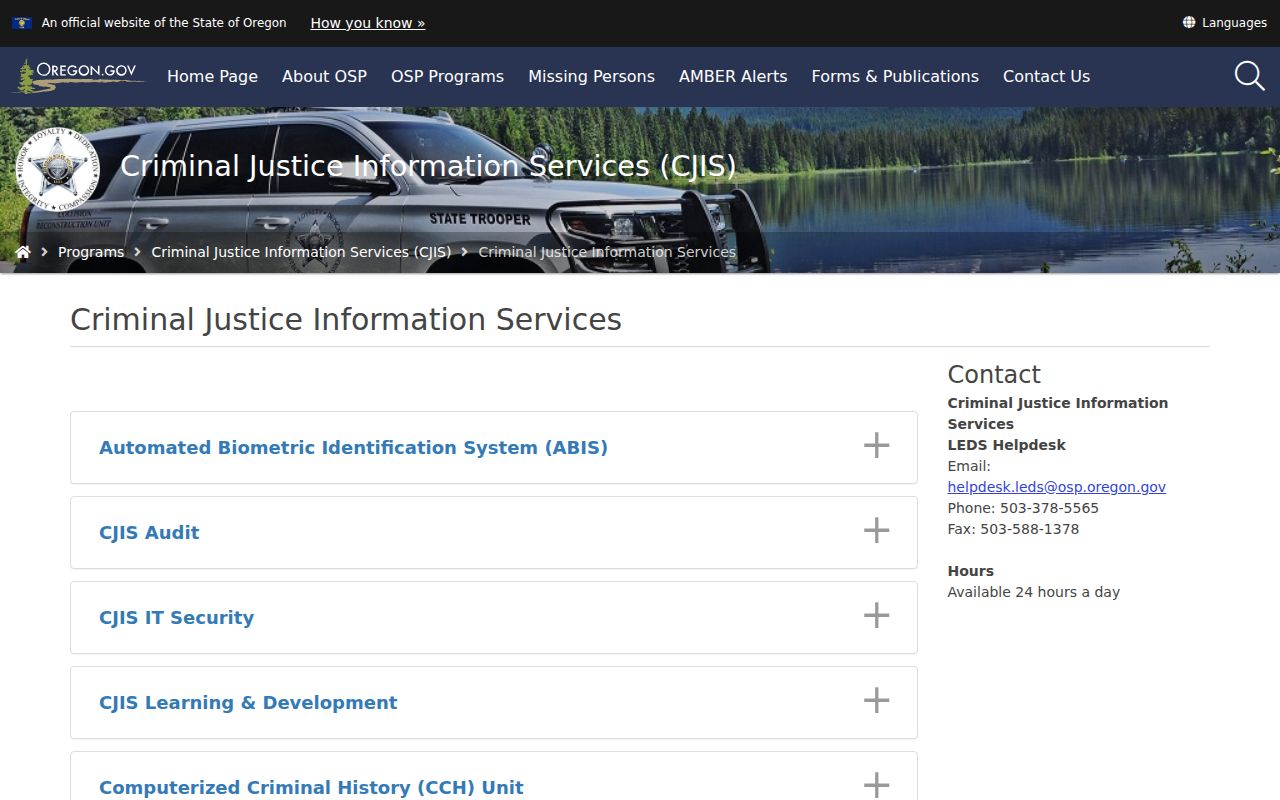
The program structure confirms that repository, network, registry, fingerprint, and statistical roles have different access rules.
OSP CJIS Oregon-Only Coverage
Both public OSP criminal history products are Oregon products. Open Record does not search every state or provide the subject's full national fingerprint history. Copy of Own Record uses fingerprints but still returns the Oregon repository file. A county record can also show a new event before its fingerprint cycle or disposition is fully matched at OSP.
Use the FBI subject-only process when the question is your own national identity history. Use OJD or the originating circuit court for the case record. Use the arresting agency for an incident report. These are complementary sources, not premium and basic versions of the same report. A local fingerprint service also does not determine whether a response comes from OSP, the FBI, or a program-specific channel.
Note: A fingerprint card is an identity input; it is not evidence that an Oregon or FBI history search has been completed.
Correcting Errors in Your OSP CJIS Record
Start with a fingerprint-confirmed copy so the disputed Oregon event is tied to your identity. Mark the exact arrest cycle, offense, or missing disposition. Then obtain authoritative proof from the original contributor. That may be a certified court judgment, a set-aside order, or an agency correction. OSP associates and disseminates submitted data, but it cannot rewrite another agency's source event based only on an assertion.
- Establish identity to OSP with written descriptors and rolled fingerprints.
- Compare the OSP entry with the originating agency and circuit-court record.
- Ask the source contributor to investigate and send its correction or supplemental disposition.
- Confirm that OSP updated CCH after receiving official contributor communication.
During an Open Record notice period, ready documentation may resolve a simple problem within the fourteen days. A complex source correction can take longer and delay release. Keep the OSP response, fingerprint receipt, certified court disposition, and contributor letter together. Each proves a different part of the correction chain.